Neuromuscular Therapy offers students a way to work with greater focus, precision, and curiosity. Instead of looking only at where discomfort shows up, this approach helps students consider the larger patterns that may be contributing to it — from trigger points and referral patterns to movement habits, muscle function, and client participation. It is targeted work, but it is also collaborative work, asking both practitioner and client to pay attention to what the body is communicating.
Offered as an elective at East West College of the Healing Arts, Neuromuscular Therapy brings together anatomy, palpation, movement, client communication, and applied kinesiology in a practical, hands-on way. Students explore trigger point work, muscle energy techniques, movement therapy, treatment planning, and the relationship between the central nervous system and the musculoskeletal system.
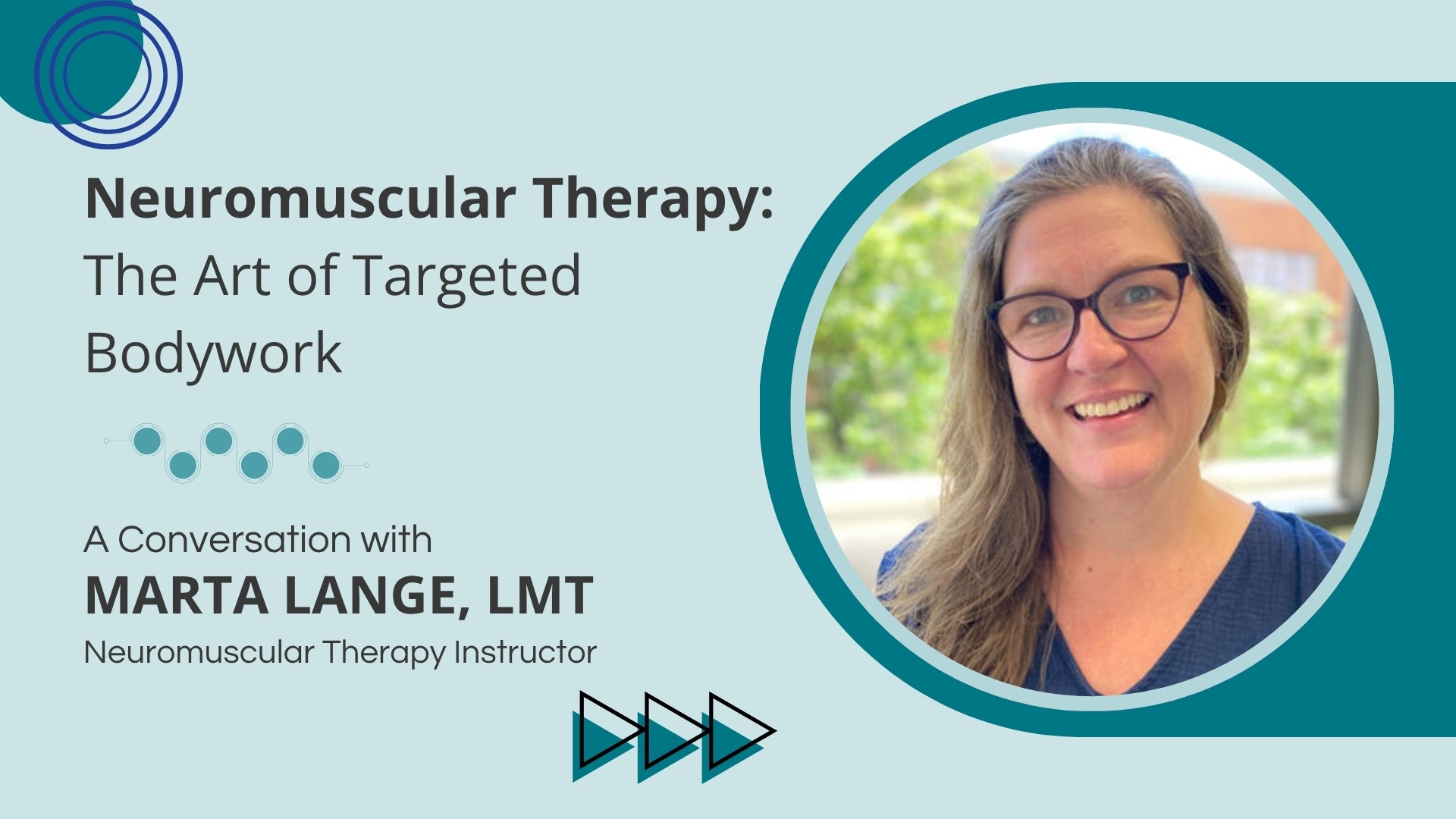
In this Q&A, Neuromuscular Therapy instructor Marta Lange shares what makes the work so useful, how students learn to connect technique with real-world client care, and how this elective can support both new massage therapists and practicing LMTs looking to refine their therapeutic skills.
Q: For someone brand new to Neuromuscular Therapy, how would you explain it?
A: I’d say Neuromuscular Therapy is a Western bodywork modality that focuses on pain relief, performance enhancement, and musculoskeletal rehabilitation. It’s a collaborative bodywork approach that focuses on current theories around the formation and treatment of trigger points.
It also uses muscle energy techniques to help engage and reset the relationship between the brain and the musculoskeletal system.
It can be a really powerful, efficient way to approach returning to normal function after an injury or surgery, and it can also help address chronic conditions effectively.
Q: What makes Neuromuscular Therapy different from other massage modalities?
A: To me, Neuromuscular Therapy brings several pieces together. It often includes trigger point work, muscle energy techniques, movement therapy, stretching, aftercare, strengthening, or mobility work. That’s one of the reasons I think it is used quite a bit in the physical therapy realm — because it includes that aftercare component. The goal is often to get clients doing self-care, looking at ergonomics, and understanding how they use their bodies outside the session.
We can bring awareness, and we can help build a client’s confidence back into their tissues, but they also need to be part of the process. To me, Neuromuscular Therapy captures the technique, the aftercare, and the client responsibility.
Q: Neuromuscular Therapy is sometimes confused with deep tissue massage. How would you describe the difference?
A: Deep tissue does not simply mean deep pressure. Ideally, it means working through the tissues in a deep, sequential way. A lot of deep tissue principles are relevant to Neuromuscular Therapy, but Neuromuscular Therapy also brings in the relationship between the nervous system and the musculoskeletal system. It often includes more active client participation, whether through movement, description, or the client’s ability to report what they are feeling.
In Neuromuscular Therapy, we really think through the layers. We address the skin and fascia in our initial assessment, and we take time to warm the tissue. We don’t just go deep quickly. Other approaches can be more passive, but Neuromuscular Therapy tends to be more collaborative.
Q: What might a client experience during a Neuromuscular Therapy session?
A: There is a lot of collaboration and client education in this work. For example, I had a client who was dealing with a chronic low back condition that had been exacerbated by a recent period of stress. She has a very physical job, and her SI joint kept going out. She would get it adjusted, get a massage, feel better for a little while, and then the pattern would come back.
She told me what her chiropractor had suggested in terms of strengthening, and I said, “Let’s try that out.” So, I wove some of the self-care into the session and walked her through it again, helping her connect with sensation and breath.
She felt more empowered and had a more immediate understanding of the benefit of doing that work, rather than it just being a theory. That is a big part of Neuromuscular Therapy — helping clients connect with what is happening in their body and understand their role in the process.
Q: What foundational skills or concepts do students build in this elective?
A: This elective gives students an opportunity to refine and enhance what they have been learning around trigger point therapy, muscle energy techniques, movement therapy, and treatment planning.
That includes listening to a client’s health history, taking a deeper dive into how people use their bodies, and considering the different stressors they have in their lives so we can create relevant, informed treatment plans.
It’s also an applied kinesiology class. For students, this can be a great class to help prepare for the MBLEX because they are actively reviewing kinesiology. It is a really good way to round out their understanding and solidify what they have been learning.
For alumni and practicing LMTs, Neuromuscular Therapy can be an opportunity to improve treatment planning, strengthen collaborative approaches with clients, and have a structured way to review and refine kinesiology knowledge.
Q: What are some common “aha” moments students have in class?
A: One big aha moment is when students feel confident that they have found their first trigger point — and then it produces a referral pattern. They find the texture, the client reports the exact referral pattern, and suddenly the concept becomes real.
Another aha moment happens when students are able to reproduce a client complaint, such as a headache, through working with the muscles of the neck. The client might say, “Oh, that’s the thing that bugs me,” and the student can feel the pathway and the texture.
Students also have aha moments when they feel how isometrics work, or how a little bit of contract-relax can help them access tissue more effectively. Applying muscle energy in real time and feeling how effective it can be when done correctly is powerful.
And then there are moments when students feel structures like subscapularis or iliacus for the first time — when they really connect with those more hidden structures and start to understand how to work with them.
Q: Why is this elective valuable, even for students who do not plan to specialize in Neuromuscular Therapy?
A: East West prepares students really well. The reference materials are there, the tools are there, and Neuromuscular Therapy gives students an opportunity to bring those tools together. For students interested in sports massage or rehabilitative work, this elective is a natural fit. But even for students who want to offer relaxation massage or Swedish massage, Neuromuscular Therapy has something to offer.
It can help students develop a more diverse approach, build confidence, refine their skills, and understand how to apply anatomy and kinesiology in a practical way. Students are often actively applying the work with clients, thinking through treatment plans, and seeing how the skills translate into practice.
It can also complement other electives. For students interested in both Eastern and Western approaches, there is a lot of opportunity to bring different perspectives together. Tuina, for example, offers strong palpation and assessment skills that can support how students engage tissue. Structural Bodywork also overlaps with Neuromuscular Therapy in useful ways, especially around myofascial work and understanding patterns in the body.
Q: What do you love most about teaching this elective?
A: I love the aha moments. I really enjoy it when I have a group that is enthusiastic about putting the pieces together and putting the practices together. It is a delight to see how much can change over the course of a term. Students might initially feel a little confused about the theory or feel like they don’t have solid footing in the concepts, but by the end of the term, I usually see their confidence building.
I see students putting together cohesive treatment plans through their case study process and really connecting the dots. It is very satisfying to watch that evolution happen in one quarter — to see increased confidence and to see outcomes.
I also really enjoy watching students refine their body mechanics. For students and LMTs who want to develop different ways to approach the work and use their bodies more effectively, Neuromuscular Therapy can be a great place to grow.
Want to explore Neuromuscular Therapy at East West?
If you’re curious about how trigger points, movement patterns, and client participation can support more effective therapeutic work, Neuromuscular Therapy is a valuable elective to consider.
This course helps bring together many of the skills students build throughout their massage education — including kinesiology, treatment planning, trigger point therapy, muscle energy techniques, and client communication, and apply them in a practical, confidence-building way. For practicing LMTs, it offers a structured opportunity to refresh anatomy and kinesiology, strengthen clinical reasoning, and bring new clarity to the way you work with clients.
Browse elective options, and reach out to the East West College Admissions Team to learn when Neuromuscular Therapy is offered and whether it may be a good fit for your goals.