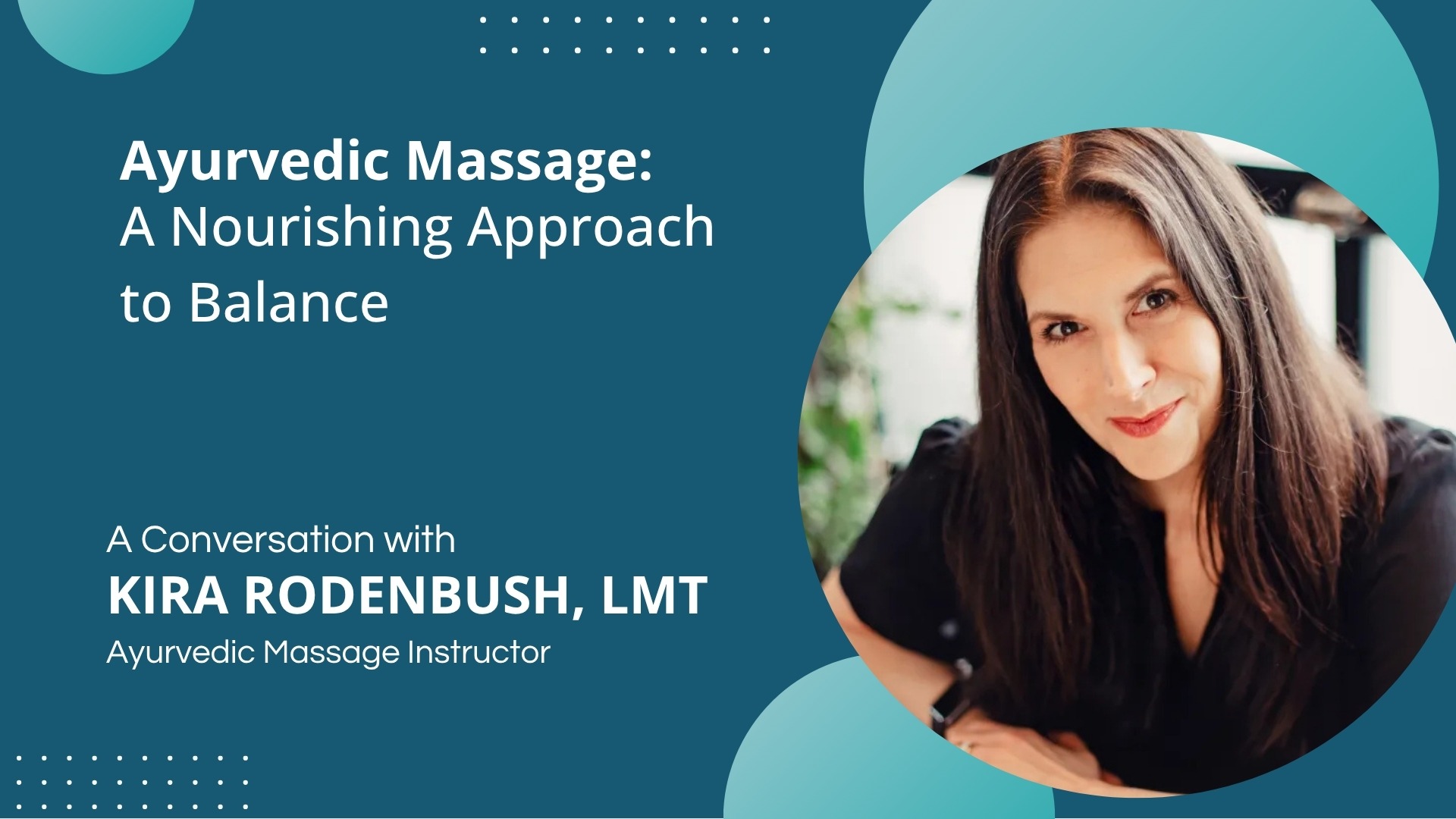
Ayurvedic Massage offers something many students and clients don’t realize they’re craving until they experience it: warmth, rhythm, nervous system support, and a more connected way of caring for the body. Rooted in Ayurveda, the ancient healing system of India, this work invites a different perspective—one that focuses less on chasing symptoms and more on restoring balance, building awareness, and trusting the body’s own intelligence.
Offered as an elective at East West College of the Healing Arts, Ayurvedic Massage introduces students to foundational Ayurvedic principles through Abhyanga, a gentle, choreographed warm-oil massage designed to calm the nervous system and support the body’s internal healing processes. In this Q&A, instructor Kira Rodenbush shares what makes Ayurveda so compelling, why this work feels especially relevant today, and what students often discover through the experience of learning it.
Q: For someone brand new to Ayurveda, how would you explain it?
A: Ayurveda is one of the ancient healing systems of India, and what’s always drawn me to it is how completely it treats the individual. To me, it goes way beyond bodywork. It’s really the science of life—the art of digestion, assimilation, and learning how we take in and process everything from food to emotions to experience.
What I love is that Ayurveda gives people a practical way to listen to their bodies. It asks: what’s nourishing you, what isn’t, and how well are you using what supports you while releasing what doesn’t? That makes it feel both deeply wise and very accessible.
Q: What makes Ayurveda such a valuable complement to modern holistic health care?
A: Ayurveda was one of the first healing systems I encountered that made me feel like the whole person was truly being considered. There’s something about its simplicity that I really appreciate. It can express something profound in a very clear, direct way.
I also think it resonates right now because it reminds us that so much of what supports healing is already around us—and already within reach. It’s not always about finding the newest fix or looking outside ourselves. So much of this work is about learning how to support what the body is already trying to do.
Q: One of the core ideas in Ayurveda is restoring balance rather than chasing symptoms. How does that show up in bodywork?
A: One of the things I appreciate most about Ayurveda is that it doesn’t approach healing from a place of judgment. It doesn’t shame people for being out of balance. I think of it more like a roadmap—it shows you where you are and how to move toward where you want to go.
That changes how you approach bodywork. Instead of trying to “fix” one symptom, you start looking at patterns, rhythms, and what the system as a whole needs. It becomes much more empowering, because once you understand how your body works, you can begin making choices that actually support it.
Q: What is Abhyanga massage, and what makes it different from other modalities students may already know?
A: Abhyanga is a choreographed, rhythmic application of warm oil designed to calm the nervous system and activate the body’s internal healing system. It’s flowing, steady, and deeply nourishing.
What makes it different is that it’s not centered on waiting for a tissue response or focusing on one isolated complaint. Even if there’s some targeted work, the overall intention is broader than that. It’s about supporting the person as a whole, helping them settle into their body, and creating the conditions for healing from within.
Q: What do clients tend to notice most when they receive Ayurvedic Massage?
A: I think many clients notice the whole-body feeling of it. Because it’s so rhythmic and flowing, it helps quiet mental chatter and gives the nervous system a chance to settle. People often start to feel more supported, more present, and more able to let go.
There’s something about the consistent, nourishing quality of the work that feels deeply regulating and helps people release. With every pass, the body is being invited to soften. It doesn’t feel aggressive or demanding—it feels supportive, and I think clients really respond to that.
Q: You mention that subtle shifts can be incredibly profound. Why does this kind of nervous system support feel especially important right now?
A: One of the beautiful things about Ayurveda is that it reminds us subtle shifts can be incredibly profound. In Ayurveda, subtle is not lesser—subtle is often the deepest medicine.
That feels especially important right now because so many people are overstimulated, overextended, and disconnected from the rhythms that help them feel steady. The idea that you could start your day by tending to yourself with warm oil, attention, and care is actually pretty radical. It’s not indulgent—it’s supportive.
Q: Ayurveda places a lot of trust in the body’s natural ability to heal. How do those foundational principles shape the way you teach this class?
A: Students begin by learning how Ayurveda understands balance through rhythm, routine, and awareness. It really comes back to listening to the body and noticing what supports you and what doesn’t.
That philosophy deeply shapes the way I teach. Ayurveda places a lot of trust in the body’s ability to heal itself, and I’m always trying to help students understand that so many of the answers they’re looking for are already in the container with them. For me, that also means emphasizing self-care as part of being an effective practitioner. If you’re exhausted, overwhelmed, or not feeling resourced enough to show up for your clients, then you need to treat yourself like a client. That’s not separate from the work. It is the work.
Q: You say Ayurveda can create meaningful change through very simple practices. What tends to surprise students most when they begin learning or receiving this work?
A: I think students are often surprised by how powerful simple things can be. We tend to think that big change has to come from something dramatic, but Ayurveda often works through small, foundational shifts.
Sometimes it’s something as basic as scraping the tongue, drinking warm water with lemon first thing in the morning, or changing the timing of meals and sleep. Students are often amazed by how much those small changes can affect how they feel. That’s one of my favorite things to witness—when someone realizes that a small shift really matters.
Q: What do students take away from this class, and how can they begin integrating Ayurvedic Massage into the work they already do?
A: Students leave with the ability to perform a full Abhyanga massage, but beyond that, I hope they leave with a different relationship to care. They learn a flowing, nervous-system-centered approach that they can integrate into other sessions, and they also gain a practical introduction to Ayurvedic principles that can shape the way they think about healing more broadly.
Even in shorter or more focused sessions, the rhythm, the nervous system support, and the sense of whole-body care can translate beautifully. I want students to feel like they can take what works and leave the rest—that they can find their own flow and bring it into their practice in a way that feels natural and authentic.
Q: You talk a lot about self-care. How does that piece deepen the Ayurvedic approach?
A: Self-care is one of the most important pieces for me. I really try to help students understand the importance of self-Abhyanga—the practice of applying warm oil to your own body. It can take five minutes or forty-five minutes, and it can be incredibly powerful.
That ritual helps people slow down, become more present, and build a stronger relationship with themselves. For me personally, it’s helped me with boundaries, grounding, and paying attention to what I truly need. I think when we care for ourselves in that way, we’re much more able to show up for others with the same presence, attention, and integrity we hope to bring to our work.
Q: For someone who feels drawn to Ayurveda but also a little intimidated by it, what would you want them to know?
A: I completely understand that feeling, because that was part of my own experience for a long time. I worried about whether Ayurveda was really for me as a Westerner, and I also felt intimidated by what seemed like a long list of rules and dos and don’ts.
What I’ve come to understand is that Ayurveda is not asking for perfection. It’s not an all-or-nothing system, and it’s not judging you. It offers rhythm, guidance, and practical ways to support yourself. You don’t have to do everything at once. You can begin with one small shift, and that matters.
Q: What do you hope students take away from this class?
A: More than anything, I hope students begin to trust that the answers they’re looking for are already in them. I hope they experience what it feels like to slow down, listen, and care for themselves with the same integrity they bring to caring for others.
I also hope they discover the power of self-Abhyanga for themselves. I think there’s something in that practice that many people are missing—a way of tending to themselves that is gentle, grounding, and deeply supportive.
Q: How has Ayurveda shaped your own path, and what do you love most about sharing this work with students?
A: Ayurveda has taught me how to be gentler with myself. It’s helped me move away from rigid thinking and more toward rhythm, awareness, and responsiveness. It’s also deepened my understanding that healing isn’t about forcing change—it’s about supporting the conditions that allow change to happen.
Teaching Ayurveda at East West feels deeply full-circle for me. I loved being a student there, and every time I came back, I felt that same sense of connection and growth. Returning to study Ayurveda there and then eventually being invited to teach it felt like coming home.
What I love most is being part of that experience for students—watching them connect with something that can support both their future practice and their own lives. There’s something really special about helping students discover work that feels both practical and meaningful.
Want to explore Ayurvedic Massage at East West?
If you’re curious about electives that support nervous system regulation, whole-person care, and a more grounded, nourishing approach to bodywork, Ayurvedic Massage is a beautiful place to begin.
Browse elective options and reach out to our Admissions Team to find out when Ayurvedic Massage is offered, learn more about the course, and whether it may be a good fit for your goals.