Craniosacral Therapy has a way of surprising people — in the best way. Many students are amazed by how much can happen when they slow down, tune in, and bring focused attention to the nervous system. As one student put it: “Wow! I didn’t expect that to be so powerful.”
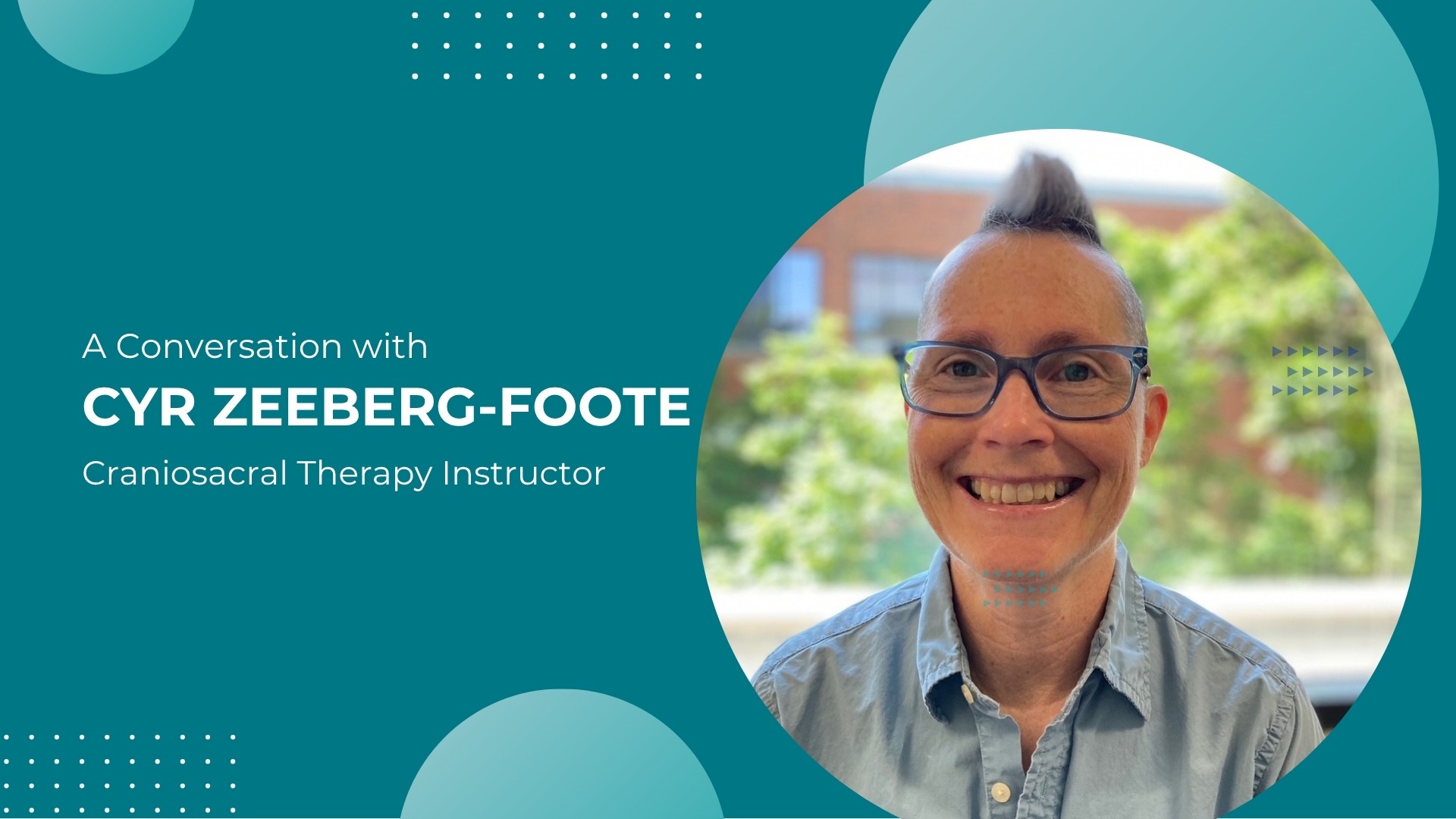
Offered as an elective at East West College of the Healing Arts, Craniosacral is a favorite for students who want to deepen presence, build confidence, and refine intuitive listening. In this Q&A, our Craniosacral Therapy instructor, Cyr Zeeberg-Foote, breaks down what it is, how it’s different, and how the elective strengthens key skills students use across all modalities.
Q: How do you explain Craniosacral Therapy to someone brand new—in one or two sentences?
A: Craniosacral Therapy is a gentle bodywork modality that works with the core of the body by supporting the nervous system. The nervous system has an incredible capacity to rebalance and recalibrate itself, and this work helps create the conditions for that to happen.
In Craniosacral, we work with the cranium, the sacrum, and the spine. By going right to the nervous system, it can feel like “massage from the inside out”—supporting not just the musculoskeletal system, but the whole body’s ability to settle, regulate, and restore. So, we’re going deep.
Q: What makes Craniosacral different from other hands-on modalities people might be more familiar with?
A: One of the biggest differences is that we let the client’s body guide the session instead of directing it. It’s much more true facilitation—we listen to the body and follow its cues, rather than deciding “I’m going to make this happen here.”
It also asks the practitioner to develop a deeper level of listening and presence. Many bodyworkers are already good listeners, but this work invites an even deeper attunement. It’s client-led, and it can feel less like a sequence of steps and more like a fine-tuned dance. Most bodyworkers are used to listening to the feedback they get when they push too hard, or when a client tells them something—but this is a different kind of listening.
Q: What can a client expect in a typical session—setting, pace, touch?
A: The first thing most people notice is how deeply relaxing it can be. Because we’re working directly with the nervous system, many clients drop into a calmer, more parasympathetic state relatively quickly—assuming it feels safe for their system to do so.
A big part of Craniosacral is that we’re not challenging the body or prying for change. Because we’re not forcing anything, the body can soften in its own time. Sometimes something that’s been guarded or held for a long time can begin to release simply because it isn’t being pushed.
There’s also something emotionally relieving about being in a space where you feel supported and not expected to perform. That lack of demand can be powerful—like your body finally has permission to do what it’s ready to do.
Q: What’s a surprising fact about Craniosacral that most people don’t know?
A: One surprising part of this work is how much it teaches you about trust—not just trusting your own skills, but trusting the body’s intelligence. In my own learning, I realized I didn’t need to “make” something happen. I needed to trust that the body has real healing capacity and will show you what it needs when you know how to listen.
That’s one of the most humbling parts of Craniosacral: it’s quiet work, but it can reveal how wise the body truly is.
Q: What are the most common reasons clients seek Craniosacral—what are they hoping for?
A: People often come in looking for support around headaches, vertigo, stress, trauma, and PTSD, as well as those in post-concussion or traumatic brain injury recovery.
Craniosacral can also be supportive for people dealing with low back pain, disc-related pain, or chronic pain—especially when the nervous system is on high alert. And for clients who need a lighter touch for any reason, this can be a really good fit. It can also be a great option for kids and infants.
Q: What benefits do clients typically notice right after a session?
A: Many people are surprised by how quickly they feel deeply relaxed. Sometimes the biggest “benefit” is that they realize how far away from relaxation they’ve been—how much stress they’ve been coping with without even noticing. It can be like finally coming down from a constant background intensity and settling back into your body. Even when that balance is temporary, it can be an enlightening experience.
Q: What surprises people most the first time they receive Craniosacral?
A: Sometimes the biggest surprise is when something significant shifts quickly. I’ve worked with people whose vertigo was so disruptive they couldn’t work—then within a session or two, it resolved. Or someone with long-term back pain realizes, “Oh my God—my back feels better.”
And then, very often, it’s the depth of relaxation—and the realization of how “wound up” their system has been. Some people also notice a shift in perspective: a little more space, a little more clarity, a sense of being more grounded in themselves. And occasionally, people experience the work in ways that feel harder to describe—subtle sensations, imagery, or a sense of expanded awareness. Not everyone experiences that, but it can happen.
A common theme is people being surprised by “less is more.” Both clients and students often realize that small, precise, patient contact can have a meaningful effect.
Q: Why is Craniosacral a valuable elective for massage therapy students—even if they don’t plan to specialize?
A: It develops your ability to listen and attune at a very high level—and that skill transfers to every modality you’ll ever practice. You learn to wait, to notice, to trust the timing of a client’s body, and to work with what’s happening rather than pushing toward an outcome.
For a lot of students, it also strengthens intuition—not in a mystical way, but as a refined internal sense of timing, rhythm, and responsiveness. It can feel like “coming home” to that part of yourself.
Q: What’s your favorite part of teaching this elective?
A: Honestly, one of my favorite parts is hearing students’ reflections and the realizations that come through as the class unfolds. People have some really beautiful ‘aha’ moments—often in a very quiet, simple setting—where they’re barely doing anything, but something clicks, and you can see it light them up.
I also love the compassion that comes out in the room. There’s so much empathy—students for each other, and students learning compassion for themselves. It can feel like a really tender, loving environment, and that energy is honestly part of what keeps me coming back to teach it.
Q: How does it complement other work a therapist may already be doing?
A: You can integrate elements of Craniosacral into many sessions—it just depends on the time you have and what the client wants. If you’re doing more thorough head work, you often need to commit enough time to work with the cranial bones (and sometimes the facial bones), so it may become a dedicated portion of the session. For example, you might do 15–20 minutes of Swedish or deeper work face down, then flip the client over and transition into Craniosacral.
Other times it’s smaller “pieces” you weave in: a diaphragmatic hold, a listening station, a synchro release, or a sacral hold/sacral decompression can be powerful—even inside a more traditional massage. Those still moments matter. Many bodyworkers feel pressure to be moving every minute, but the body often welcomes stillness. Integration is not wasted time—it’s where a lot of the work settles in.
Q: What would you want a student to know before choosing this elective?
A: It helps to have some openness to slowing down. If speed is your comfort zone, this work may feel challenging at first. It’s also important to know this is a fine-art kind of skill. It often takes time. The work is subtle, and the learning process is also slower. If you can be patient with that, it can be incredibly rewarding.
Q: What’s a common ‘aha’ moment students have in class?
A: “Less is more” is a big one. Students are often surprised by how little they need to do—and how much can happen when they stop trying to find the answer and instead let it come to them.
Want to explore Craniosacral at East West?
If you’re curious about electives that build deep listening, nervous system awareness, and a more client-led approach, Craniosacral Therapy is a powerful place to start.
Browse elective options and reach out to our Admissions Team to confirm when the Craniosacral Therapy elective is offered, what the course includes, and whether it’s a good fit for your goals.