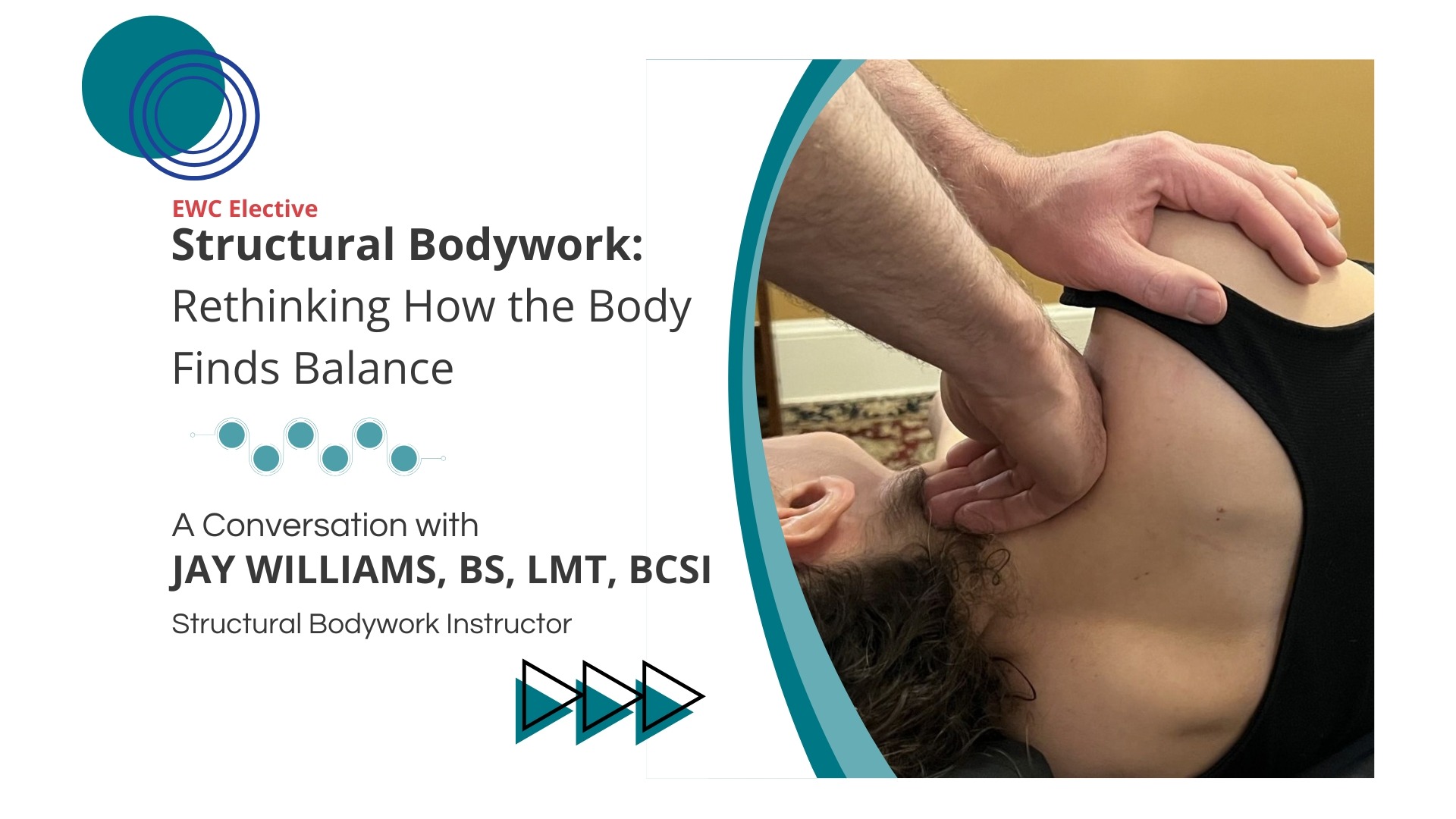
Structural Bodywork invites students to look beyond a single muscle, symptom, or area of discomfort and consider how the body organizes as a whole. Instead of assuming that one structure is the cause of a problem, this approach explores relationships throughout the fascial system – including how the feet, legs, pelvis, spine, and upper body may influence one another.
Offered as an elective at East West College of the Healing Arts, Structural Bodywork brings together myofascial techniques, visual body reading, movement, client collaboration, and practitioner body mechanics. Students explore different territories of the body while learning to work with greater curiosity, responsiveness, and awareness of how the body adapts within gravity.
In this Q&A, East West graduate and Structural Integration practitioner Jay Williams, who helped revise and teach the Structural Bodywork curriculum, shares how the elective changes the way students see the body, what they experience in the course, and why its lessons can support many different approaches to massage therapy.
Q: For someone brand new to Structural Bodywork, how would you explain the elective?
A: East West first gives students a strong foundation in massage techniques, anatomy, kinesiology, assessment, and pathology. Because students are building those essential skills, much of their early education naturally focuses on symptoms and what to do in a particular area.
Structural Bodywork begins to shift that framework. Students start looking at the body as a whole system rather than as separate parts. We explore how the body is interconnected through the fascial web, how different regions influence one another, and how the entire system organizes within gravity.
The course also introduces bodywork as a process. Instead of deciding on one outcome and trying to make it happen, students learn to create a thoughtful container in which they can observe how a person’s system changes over time.
Q: How is that whole-body perspective different from simply working where a client has pain?
A: Symptoms still give us valuable information, but we do not have to let them dictate the entire session. If someone repeatedly experiences headaches, for example, working with the head and neck may offer relief. Structural work also asks what we might learn by working elsewhere in the system.
What happens if we work with the feet and lower legs without touching the head and neck? If something changes above, that does not prove the feet caused the headaches. It does show us there may be a relationship.
Our analytical minds like cause-and-effect stories, but every person has a unique history of injuries, experiences, habits, and movement patterns. When we decide too quickly that one thing caused another, we can limit what we are able to notice. Structural work encourages students to stay curious about relationships throughout the whole system.
Q: The course description talks about helping the body become more balanced in gravity. What does that mean?
A: Gravity is a constant force, and our bodies are always organizing within it. I sometimes use the image of blocks stacked on top of one another. When the blocks are well stacked, they remain upright without additional support. When one block shifts forward and another shifts back, something has to create tension to keep the structure standing.
Our bodies do something similar. Injuries, habits, and movement patterns can change how different segments relate to one another. The body adapts because its priority is to keep us upright and functioning.
Structural work looks at how we can create more balance between those segments so the system requires less effort and has more movement options available. The goal is not perfect posture. It is greater efficiency, adaptability, and freedom to organize in different ways.
Q: What do students do in the elective?
A: Students learn hands-on approaches for different territories of the body, including areas they may not have explored as extensively in other classes. One example is working with the adductors and their attachments near the pelvis. That region can be influential because of its fascial relationships throughout the pelvis and surrounding structures.
Students also practice visual body reading, embodiment, and practitioner body mechanics. Each class begins with an embodiment activity related to the territory being studied so students can connect the material with their own lived experience.
A central assignment is a five-session case study with the same outside model. Each session focuses on a different territory. Students can observe what changes over time, what carries forward from one session to the next, and what happens elsewhere in the body when they work primarily with one region.
Q: What are some of the biggest ‘aha’ moments students have in class?
A: One often happens during visual body reading. Students are accustomed to looking for what is not working well, so we ask them to identify three things in a person’s structure that are working well. That can be surprisingly difficult at first.
Eventually, students realize that what is working well gives us context. We can recognize that something has moved away from balance because other places in the system show us integrity and organization. That is a major shift – from searching for one defective part to noticing relationships across the whole body.
Another aha moment comes through body mechanics. Students begin to realize they do not have to work as hard to support change. When practitioners find more ease in their own bodies, they often notice that the client’s tissue responds differently too.
Q: Why are practitioner presence and client collaboration so important in this work?
A: Many people enter massage because they want to help, and it can be easy to think that helping requires us to constantly do something to the client’s body. Structural work invites a different question: Can I stay connected while also creating enough space to listen?
The client’s experience is part of the process. Assessment and visible structural changes can tell us useful things, but we also ask what the client notices and how they experience their body. Rather than the practitioner deciding, ‘This is wrong and I need to fix it,’ practitioner and client can listen to the system together.
The practitioner’s body matters too. We ask students to notice their base of support, find their back body, and explore whether they can achieve the same intention with less effort. That awareness can improve responsiveness in the session and support greater longevity in a massage career.
Q: What would you say to a student who is interested in Structural Bodywork but feels intimidated by the elective?
A: It helps to remember that this is an introductory elective, not a complete Structural Integration training. Students are not expected to arrive already knowing how to see or work with every structural pattern.
There are different layers available depending on where someone is in their learning. A student who is still building confidence with kinesiology can practice the demonstrated techniques and observe what happens. Another student may already be making more detailed connections between structure, movement, and tissue. Both can learn from the course.
There is meaningful outside work, including reading, reflective assignments, embodiment practice, and the case study. But the emphasis is exploration rather than finding one right answer. Students are asked to notice, reflect, and engage with the process.
Q: Why is this elective valuable for students who do not plan to become Structural Integrators?
A: The course can support many different paths. Someone planning to work in a spa may carry forward better body mechanics and a more intentional quality of touch. Someone working in a chiropractic or therapeutic setting may begin incorporating structural or myofascial approaches right away.
Some students discover that Structural Integration is exactly where they want to continue their education. Others decide it is not their specialty, and that is useful information too. Electives are designed to let students explore where they may want to go deeper.
It is important to distinguish this elective from full Structural Integration training. Students do not graduate from the elective as Structural Integrators, but they can integrate structural deep-tissue or structural myofascial techniques into their massage work. Even if all someone takes from the course is greater ease in their own body and a broader way of seeing the client, that can influence every kind of massage they offer.
Q: What do you enjoy most about teaching Structural Bodywork?
A: I love helping students discover the creativity in their own work. I can demonstrate techniques, but there may be a thousand ways to approach the adductors or any other area. The technique is a starting point. The larger questions are: What are you noticing under your hands? What is this particular system asking for? What happens if you try something different?
During trades, I enjoy seeing a student recognize that they have found something even if they do not yet know how to name it. We can start putting language around what they sense and exploring how they might respond.
Massage therapy is a healing art. Giving students permission to be curious, creative, and responsive – while also finding ways to work that are sustainable for their own bodies – is probably what I enjoy most.
Want to explore Structural Bodywork at East West?
If you are curious about how fascia, gravity, movement patterns, and client awareness can shape a massage session, Structural Bodywork is a valuable elective to consider.
This course helps students bring together anatomy, kinesiology, palpation, myofascial techniques, visual body reading, client communication, and practitioner body mechanics in a practical, whole-body way. For practicing LMTs, it offers an opportunity to revisit familiar skills through a different lens, expand treatment options, and explore whether structurally oriented work may be a direction for deeper study.
Browse elective options, and reach out to the East West College Admissions Team to learn when Structural Bodywork is offered and whether it may be a good fit for your goals.