“The work is not about creating one ideal posture or imposing a specific shape. It is about efficiency, adaptability, and options.”
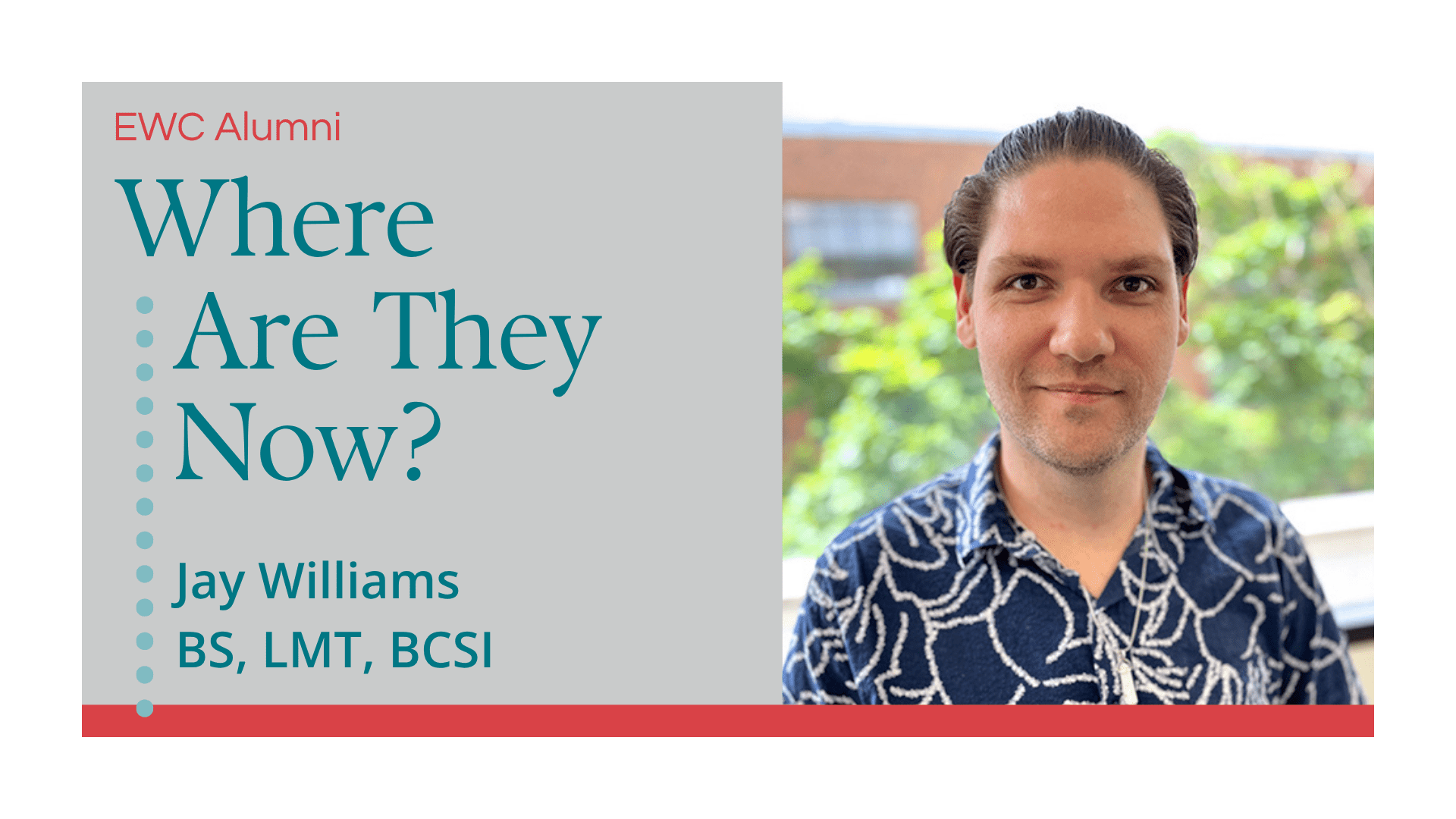
When Jay Williams graduated from East West College in 2021, he already knew he wanted to help people create meaningful change through bodywork. What he didn’t yet know was how much one area of study would shape the direction of his career.
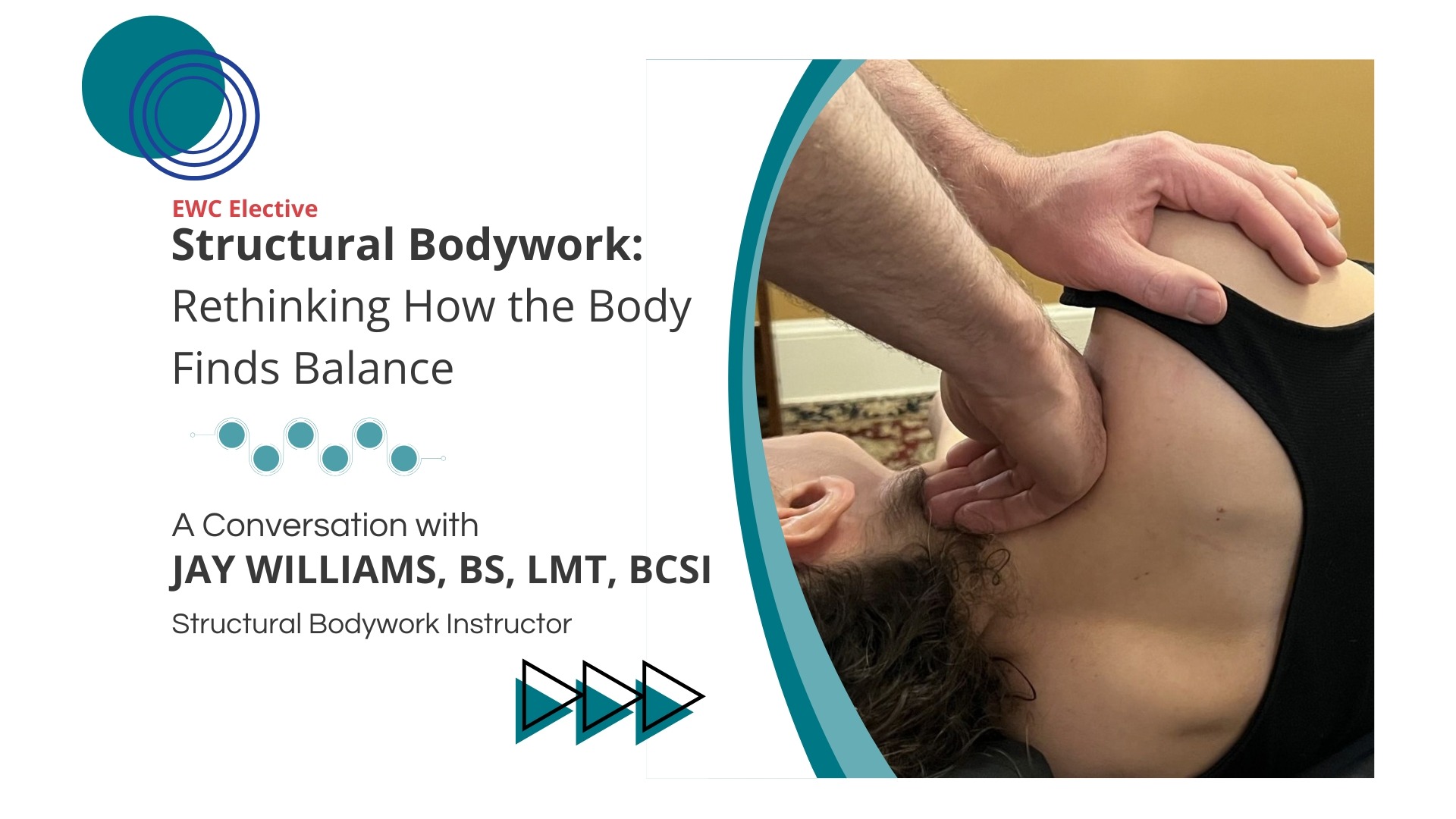
After graduation, Jay returned to East West to take the Structural Bodywork elective. He expected to add new techniques to the massage foundation he had already built. Instead, he encountered a different framework for understanding the body—one that looked beyond individual muscles or symptoms to consider how the entire system works together.
“For me, the elective supplied a piece I felt was missing after my foundational massage education,” Jay says. “I knew I could be a good bodyworker and support change, but the elective gave me a framework for recognizing the person as a whole system.”
That perspective stayed with him.
Jay began his massage career working in a chiropractic office, where he incorporated structurally informed deep tissue work into sessions with clients experiencing pain, tension, and movement restrictions. As he gained experience, he became increasingly interested in the relationships between different areas of the body—and in what could change when a practitioner looked beyond the place where symptoms were showing up.
Structural work encouraged him to ask different questions. Rather than assuming that pain in one area could be traced to a single cause, he learned to look for relationships throughout the body: How might the feet influence what is happening at the hips or low back? How is the pelvis organizing over the legs? What patterns has the body developed in response to injury, movement habits, or other experiences?
That curiosity eventually led Jay into more extensive Structural Integration training. He attended the Soma Institute for Structural Integration, graduating in 2023 and becoming a Board Certified Structural Integrator.
Today, that whole-system perspective forms the foundation of his private practice in Oregon City. His work has expanded to include external pelvic floor bodywork, and he has pursued additional education in areas including pelvic floor work, BoneWork, cranial work, and neurovascular mobilization.
For Jay, however, Structural Integration is about more than applying increasingly specialized techniques. It changed the way he thinks about the role of the practitioner.
Rather than approaching bodywork as something a practitioner simply “does” to a client, Jay sees it as a collaborative process. The practitioner brings knowledge, observation, and touch, while also paying attention to the client’s own experience of their body. Changes in sensation, movement, awareness, and organization all become part of the conversation.
It is also a perspective that emphasizes adaptability rather than an idealized version of posture or alignment.
“The work is not about creating one ideal posture or imposing a specific shape,” Jay explains. “It is about efficiency, adaptability, and options.”
As his own practice deepened, Jay began thinking about how more practitioners could gain access to Structural Integration education. In 2023, he began working with other Structural Integration practitioners and mentors in Portland to explore the possibility of developing a local training program.
That work grew into the Inner Dynamics Alliance for Structural Integration (IDA-SI), which became an Oregon nonprofit in 2024. Its mission is to expand access to Structural Integration education and services, particularly for people who may otherwise face geographic or financial barriers to the work. IDA-SI has since been recognized by the International Association of Structural Integration as an approved Structural Integration basic training program.
Jay’s evolving relationship with Structural Integration also brought him back to East West for another chapter—as an instructor.
During his time teaching the Structural Bodywork elective, Jay also helped revise the course curriculum, bringing more emphasis to embodiment, practitioner awareness, reflective learning, and the philosophy behind structural work while maintaining its hands-on techniques and anatomical foundations.
Teaching gave Jay another way to explore what it means to develop as a practitioner. Rather than encouraging students to search for one “right” technique, he focused on helping them build awareness, curiosity, and creativity in their work.
During hands-on practice, a student might notice something beneath their hands without yet knowing exactly how to describe it. Jay’s approach was to help them become curious: What are you noticing? What changes when you approach it differently? Can you accomplish the same intention with less effort?
He also encouraged students to pay attention to their own bodies while they worked. Better body mechanics, greater awareness, and learning to work with less unnecessary effort can support not only the quality of a session, but the longevity of a massage career.
“Massage belongs to the healing arts; it is an art form,” Jay says. “Students need permission to explore rather than assuming there is one perfect way to work.”
That willingness to explore has been a consistent thread through Jay’s own career. What began with massage training at East West has expanded into advanced Structural Integration education, specialized pelvic floor work, a private practice, teaching, and the development of a nonprofit dedicated to making Structural Integration training more accessible.
His path is also a reminder that a massage career does not have to follow a predetermined trajectory. A class, a technique, or simply a new way of seeing the body can open a direction you did not anticipate—and continuing to follow that curiosity can gradually shape a practice that becomes distinctly your own.